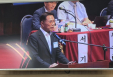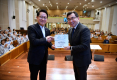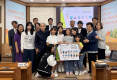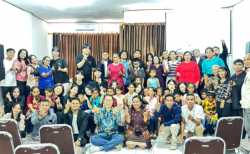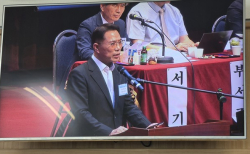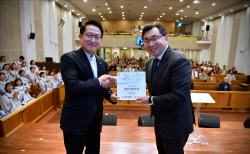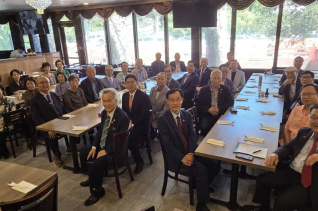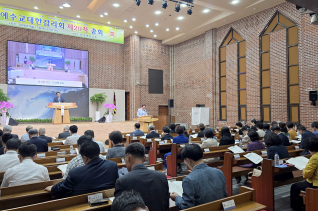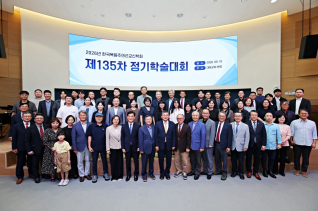


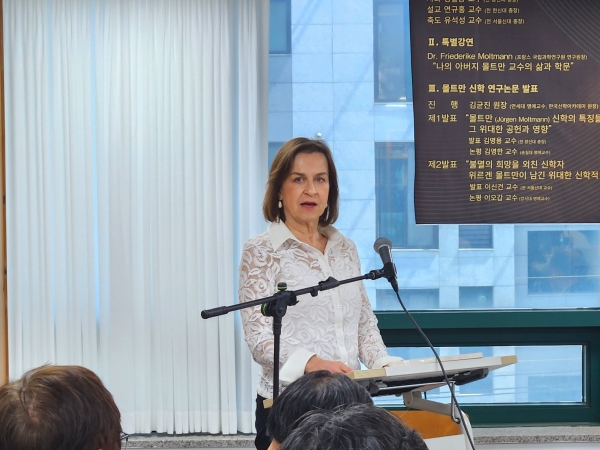
※ 한국신학아카데미(원장 김균진 박사)는 8일 오후 서울 안암동 세미나실에서 ‘희망의 신학자 몰트만 교수의 삶과 신학’을 주제로 학술세미나를 개최했습니다. 아래 글은 이날 세미나에서 몰트만 교수의 딸인 프리데리크 몰트만 박사(Friederike Moltmann·프랑스 국립과학연구원 연구원장)가 ‘나의 아버지 몰트만 교수의 삶과 학문’ 주제로 특별강연을 한 것입니다-편집자 주
Juergen Moltmann: The Father and the Thinker
For the Centennial Celebration of Juergen Moltmann in Seoul, South Korea
Friederike Moltmann
Seoul May 8, 2026
You all know my father as theologian, an immensely productive, creative, and visionary, theologian. For me he was of course a father as well. In addition, he was important for me as a role model and mentor for my own academic career, a role that he cared a lot about himself. In what follows I first want to talk about my father as a family man, of a family of four daughters, as a husband of another theologian, my mother Elisabeth Moltmann-Wendel, and as a role model for an international academic career. Second, I will talk about my father’s favorite thinker image the Korean pensive Bodhisattva, since that image itself also reflects the nature of my father as a thinker.
1. My father as a father
When growing up, we daughters always were aware that our father was very much focused on his work and was not easily available. His work went along with a strict discipline, in particular as a precise daily routine: Getting up shortly before 8am, breakfast at 8.15al, when we were already on our way to school. Then taking a walk in the nearby forest to gather his thoughts for a day’s work of writing - four pages in the morning and four pages in the afternoon during my father’s heyday. Then lunch at exact 12.30, usually prepared by my mother, but later also once a week by my father, to unburden my mother when she had resumed her career own again. After lunch, a ‘sacred’ siesta till 15.00. Subsequently, my father was at his desk again till 18.30. In the evening he usually made some time to be with his family, to watch some television together or to just talk, before retreating again around 9.30pm to gather his thought for the work of the next day or for future projects. This was often accompanied by classical music - Beethoven was his favorite, but also jazz, later he preferred Mozart. He kept such a discipline throughout his life, until his last days. It was certainly one of the foundations for producing such an immense work.
Unlike other prominent academics, he made a point of letting us in in his work. We often discussed theological or other intellectual issues, and he took us along to talks or sermons in churches. He thus let us take part in the deep joy he gained from his work as well as the pride in his international recognition and international invitations. He loved to take one or the other daughter along to a professional trip. For example, I remember well a trip when I was around thirteen. My father took me along to a theology conference to Prague and we visited the shadow theater Laterna Magica in the evening. He also made time for local excursions, to our vacation home in the Swabian alps, to nearby forests or spas, or to important monasteries, churches or other sights (my Prussian mother liked palaces, my father preferred churches). Visits of places of culture sometimes involved the whole family. I remember well a family trip to Dresden, where we visited both museums and the Semper Opera together, as well as the Meissen porcelain manufacture and a beautiful shop with wooden nutcrackers and other figures from Germany’s Erzgebirge. Such excursions continued until his last years.
Particularly noteworthy were his travels to visit me in Venice during the pandemic. I had moved from New York to Venice shortly after the pandemic started, knowing that it would be a historically unique occasion to experience Venice without the tourists that usually overwhelm most of the city. Well into his nineties, my father was thus able to visit me there three times, twice together with my sister Esther. These were deeply moving and joyful experiences for the three of us.
During that time, my father had started a new friendship with the patriarch of Venice Francesco Moraglia, whom we visited several times either in the sacristy of San Marco after a mass or in the patriarchal residence next to the basilica San Marco.
The patriarch of Venice organized a private guided tour of San Marco for us with special access to the golden altarpiece of San Marco, which had captivated my father:
The Patriarch also honored my father by elaborating on his theology of hope during the mass in San Marco for the celebration of the 1600 year anniversary of the founding of Venice in 2021, a mass of which we were honorary guests.
We also were able to undertake ‘VIP tours’ of the spiritual islands of San Francesco del Deserto and San Lazzaro degli Armeni in the Venetian Lagoon, again enjoying special guided tours.
During ‘Zona Rossa’, the period when almost everything was closed in Italy, my father stayed in the only hotel open at the time, the magnificent Danieli hotel, a five-star hotel, which immediately upgraded my father’s room to a penthouse suite when they learned who he was. Each evening during that stay, I had dinner with my father on the roof top terrasse, almost the only people in the restaurant at the time. Each time after dinner, father asked to stay on at the table by himself for another half hour, contemplating the beautiful view of Venice, especially Santa Maria della Salute.
During those visits in Venice, my father also cared deeply about the bond that was strengthening between me and my sister. The visits of Venice are great example of the renewal of life and personal development that my father sought after my mother’s death.
My father’s love toward my mother had been profound: theirs was a highly symbiotic relationship, and they each regarded the other as ‘the great fortune of my life’. My mother’s death, even though it she had been very ill for some years, had devastated my father. Yet he found the strength to renew his life, with new ideas and publications, new travels, new friendships, and a deeper cultivation of family relationships. What had attracted my father most to my mother, on my view, was her deep joy of life and the encouragement and support she gave him. After my mother’s death, I had an artist friend from New York make a portrait of my mother on the basis of an early photograph, which I found represented those two qualities best:
My father was in tears of joy when he received it.
Besides the trips and excursions, my father always made time when one of us daughters had a serious problem or was in serious need. He then was very generous with his attention and care as well as with follow-ups. Another remarkable quality of my father as a family man was is sense of equality: he made sure to treat all of his daughters equal, whether with his time and attention or materially.
My father had a special importance to me, as his only daughter that had pursued an international academic career. My own academic career is in a rather field, the interface between linguistics and philosophy, which is driven by a strict empirical and formal methodology. My father was initially reserved when after the first year of my studies, I chose analytic philosophy and theoretical linguistics rather than historical and continental philosophy as he had expected. But soon after he embraced my passion for such a formal and analytic field, with a methodology so different from his own, and he became a pillar of continuous support of my career throughout my studies and professional life. He even sometimes contributed good linguistic examples from the theological realm when I told him about a topic I was working on. I can call myself immensely blessed to have had such a great role model for an academic career.
2. My father’s favorite thinker image
My father’s study was filled with books, including of course his own books and their numerous translations. But it also contained a great number objects of art, such as icons, woodblock prints, sculptures, and lacquer boxes. My father thought in images, and certainly the selection of art objects surrounding him in his study were sources of inspiration.
The most distinguished place for such objects of inspirations was the window board above his desk. The large window of his study had a stunning, sprawling view of the outskirts of Tuebingen and the adjacent countryside, with the Swabian alps being well visible in the distance. One of the figures on that board was a bronze reproduction of the Korean pensive bodhisattva. In this photo of my father of early 2024 we can see the small Bodhisattva statue at the window:
Here is a close-up of the Korean statue on that window board:
My father had two other small reproductions of the Korean pensive bodhisattva in our home. One of them stood on the window board of the ‘Asian room’, a reading room filled with Asian paintings sculptures and vases adjacent to his study. Another one stood in the living room surrounded by the blue-white porcelain collection that was the pride of my mother:
The Korean pensive Bodhisattva also figured in a framed photograph in the Asian room and on a postcard that my father had sent me from one of his first trips to South Korea.
Here we see two particularly important examples of the pensive Bodhisattva, the two national treasures in in the Korean National Museum in Seoul:
Besides the pensive Bodhisattva, the dancing Shiva of hinduism was a divine (non-Christian) image that that my father was particularly drawn to, that is, the dancing god that destroys and recreates the world, for my father a personification of creativity:
I was lucky to inherit my father’s wooden shiva statue, which always reminds me of my father’s creativity and inspires me for my own.
There are particular reasons why my father was so drawn to the pensive Bodhisattva. First, it has to do with what the Bodhisattva represents to the theologian of hope: it is the representation of Maitreya, the Buddha of the future, that is the Buddha that reappears on earth in some distant future. It is also the Buddha that helps humans obtain enlightenment, serenity, and eternal joy. This of course not only resonates with the theologian of hope, but also constitutes a link between Buddhism and Christianity. Hope is fundamental to Christian faith, on my father’s view, that is, hope is for the real world, not for a realm of heaven beyond it
However, it is also the bodily position of the bodhisattva my father was so attracted to. This can be appreciated when we contrast the Korean thinker with the most well-known thinker statue in the Western world, the thinker of Auguste Rodin:
Rodon’s thinker represents a rather tortured and very male, muscular thinker. The act of thinking here is represented as a difficult, almost painful act, which imposes stress on mind and body. This contrasts strikingly with the pose of the pensive Korean Bodhisattva, which is serene, almost relaxed. This holds both for the overall sitting pose and the way the hand gives only light support of the chin. The Korean bodhisattva shows grace and lightness and a smiling face, even when being aware of death of suffering, and its appearance seems neither masculine nor feminine.
My father was so attracted to the Korean thinker that he subconsciously liked to adopt the very same thinker pose himself. This is particularly striking in one of his best-known portraits:
This portrait shows my father’s own characteristic thinker pose, which is that that of the Korean pensive Bodhisattva, not that of Rodin’s thinker. The Korean Bodhisattvas shows serenity and lightness even in face of suffering, features that are characteristic of my father himself when at his best.
I never had a general conversation about thinker statues with my parents. However, the thinker image recurs in other places in our family. Thus, when I was to choose a cover for my recent book Objects and Attitudes (Oxford UP, 2024), I decided on a photograph of the Korean national treasure in the National Museum of Seoul, in part recalling my father’s love for the Korean thinker:
My father was still able to see the cover of the book, but unfortunately not the book itself when it came out at the end of 2024.
In addition, one of the favorite photographs my father had of my mother was one where she herself adopted the thinker pose, though not quite that of the Korean pensive Bodhisattva. The photo hung in my father’s study since her death:
My mother herself had a favorite portrait of me in her study, namely my self-portrait at the age of 15 as a thinker:
I would like to add a final remark about thinker images in general and the Christian tradition in particular. in general. From all I can tell, my father was not aware of a broader tradition of thinker images. But both my parents with their interest in the representation of concepts through images would have been keen to learn that there were fascinating traditions of representing thinkers across different cultures. My mother would have loved to see female thinkers being represented in various cultures or historical periods. My father would have been interested in the Christian tradition of the pensive anxious Christ, so different from the Korean thinker. Here is an example of that tradition, a woodblock print by Albrecht Duerer (1511):
Though the pensive Christ in the Northern and Eastern tradition displays suffering without serenity, lightness, or hope, my father would have been thrilled to learn about a contemporary monumental sculpture (2009) in the Italian Dolomites:
That sculpture situates itself in that same Christian tradition, but represent not only suffering, but also hope. Its inscription encourages the viewer to not only think and pray, but also to smile, in English translation:
‘Take the time to think, Take the time to pray, Take the time to smile’.
This inscription recalls my father’s own famous saying:
‘God weeps with us so that we may someday laugh with him.’
위르겐 몰트만: 아버지이자 사상가
대한민국 서울에서 열린 위르겐 몰트만 탄생 100주년 기념행사를 위하여
프리데리크 몰트만
서울, 2026년 5월 8일
여러분은 모두 제 아버지를 신학자로 알고 계십니다. 그는 대단히 생산적이고 창의적이며 비전을 지닌 신학자였습니다. 그러나 제게 그는 물론 아버지이기도 했습니다. 더 나아가 그는 제 학문적 여정에서 롤모델이자 멘토로서 중요한 존재였습니다. 그리고 그러한 역할은 아버지 자신에게도 매우 중요한 일이었습니다.
오늘 저는 먼저 네 딸의 아버지로서, 또 다른 신학자인 제 어머니 엘리자베스 몰트만-벤델의 남편으로서, 그리고 국제적인 학문 경력을 위한 본보기로서의 아버지에 대해 말씀드리고자 합니다. 둘째로는, 아버지가 가장 사랑했던 사상가의 이미지인 한국의 ‘반가사유상’에 대해 이야기하려 합니다. 그 형상 자체가 아버지의 사유 방식과도 깊이 닮아 있기 때문입니다.
1. 아버지로서의 나의 아버지
우리가 자라던 시절, 딸들은 모두 아버지가 자신의 일에 매우 몰두해 있었고 쉽게 시간을 내는 분이 아니라는 것을 알고 있었습니다. 아버지의 삶은 엄격한 규율과 함께했습니다. 특히 하루 일과는 매우 정확하게 정해져 있었습니다.
아침 8시 직전에 일어나셨고, 8시 15분에 아침식사를 하셨는데, 그때는 이미 저희가 학교로 가고 있을 시간이었습니다. 이후 집 근처 숲을 산책하며 하루의 집필을 위한 생각을 정리하셨습니다. 아버지의 전성기에는 오전에 네 페이지, 오후에 네 페이지씩 글을 쓰셨습니다.
점심은 정확히 12시 30분이었고 대개 어머니가 준비하셨지만, 훗날 어머니가 자신의 경력을 다시 이어가게 되자 아버지가 일주일에 한 번씩 직접 식사를 준비해 어머니의 부담을 덜어주셨습니다. 점심 이후에는 오후 3시까지 ‘신성한’ 낮잠 시간이 이어졌습니다. 이후 다시 저녁 6시 30분까지 책상에 앉아 일하셨습니다.
저녁에는 대개 가족과 시간을 보내셨습니다. 함께 텔레비전을 보거나 이야기를 나누었고, 밤 9시 30분쯤이면 다음 날의 작업이나 미래의 프로젝트를 위해 다시 생각에 잠기곤 하셨습니다. 그 시간에는 종종 클래식 음악이 함께했습니다. 베토벤이 가장 좋아하는 작곡가였고 재즈도 즐기셨으며, 말년에는 모차르트를 더 선호하셨습니다. 그는 마지막 날들까지도 이 규율을 유지했습니다. 그리고 그것은 방대한 저작 활동의 토대 가운데 하나였음이 분명합니다.
다른 유명 학자들과 달리 아버지는 자신의 작업 세계를 우리에게 기꺼이 열어주셨습니다. 우리는 종종 신학이나 다른 지적 주제들에 대해 이야기를 나누었고, 아버지는 강연이나 교회 설교에도 우리를 데려가셨습니다. 그렇게 우리는 아버지가 자신의 일에서 얻는 깊은 기쁨과 국제적 인정 및 초청에 대한 자부심을 함께 나눌 수 있었습니다.
아버지는 전문적인 출장에 딸들 중 한 명을 데려가는 것을 좋아하셨습니다. 제가 열세 살쯤 되었을 때 프라하의 한 신학 학회에 함께 갔던 기억이 생생합니다. 저녁에는 ‘라테르나 마기카(Laterna Magica)’ 그림자극도 관람했습니다.
또한 아버지는 지역 여행을 위한 시간도 만드셨습니다. 슈바벤 알프스의 별장, 근처 숲과 온천, 수도원과 교회, 여러 명소들을 찾았습니다. 프로이센 출신인 어머니는 궁전을 좋아하셨고, 아버지는 교회를 더 좋아하셨습니다. 문화 유적지를 방문할 때는 온 가족이 함께하곤 했습니다. 드레스덴 여행에서는 박물관과 젬퍼 오페라극장, 마이센 도자기 공방, 그리고 독일 에르츠게비르게 지방의 나무 호두까기 인형 가게를 함께 방문했던 기억이 납니다. 이런 여행들은 아버지의 말년까지 이어졌습니다.
특히 기억에 남는 것은 팬데믹 기간 중 베네치아에서 저를 방문했던 여행들입니다. 저는 팬데믹 직후 뉴욕에서 베네치아로 이주했습니다. 관광객으로 넘쳐나는 평소와 달리, 역사상 유일무이하게 조용한 베네치아를 경험할 수 있으리라 생각했기 때문입니다.
아버지는 90대가 훨씬 넘은 나이에도 세 차례나 저를 방문하셨고, 그중 두 번은 제 여동생 에스더와 함께였습니다. 그것은 우리 셋 모두에게 깊은 감동과 기쁨의 시간이었습니다.
그 시기 아버지는 베네치아 총대주교 프란체스코 모랄리아와 새로운 우정을 쌓고 계셨습니다. 우리는 산 마르코 성당 미사 후 성구실이나 성당 옆 총대주교 관저에서 여러 차례 그를 만났습니다.
베네치아 총대주교는 우리를 위해 산 마르코 성당 특별 안내 투어를 마련해 주었고, 아버지가 매료되었던 황금 제단화까지 가까이서 볼 수 있게 해주었습니다.
또한 그는 2021년 베네치아 건립 1600주년 기념 미사에서 아버지의 ‘희망의 신학’을 언급하며 아버지에게 특별한 경의를 표했습니다. 우리는 그 미사의 귀빈으로 초청받았습니다.
우리는 베네치아 석호의 영적인 섬인 산 프란체스코 델 데세르토와 산 라차로 델리 아르메니를 방문하는 특별 투어도 경험할 수 있었습니다.
이탈리아 대부분이 봉쇄되었던 ‘조나 로사(Zona Rossa)’ 시기, 아버지는 당시 유일하게 문을 연 호텔인 화려한 5성급 다니엘리 호텔에 머무셨습니다. 호텔 측은 아버지가 누구인지 알게 되자 곧바로 펜트하우스 스위트룸으로 객실을 업그레이드해 주었습니다.
그 기간 동안 저는 매일 저녁 아버지와 함께 옥상 테라스에서 식사를 했습니다. 당시 식당에는 거의 우리밖에 없었습니다. 식사 후마다 아버지는 홀로 30분 정도 더 그 자리에 머물기를 원하셨습니다. 아름다운 베네치아 풍경, 특히 산타 마리아 델라 살루테 성당을 바라보며 사색에 잠기셨습니다.
베네치아 방문 동안 아버지는 저와 여동생 사이의 관계가 더욱 깊어지는 것도 매우 기뻐하셨습니다. 이 방문들은 어머니의 죽음 이후 아버지가 추구했던 삶의 새로움과 개인적 성숙을 잘 보여주는 예였습니다.
아버지의 어머니에 대한 사랑은 매우 깊었습니다. 두 분은 서로를 “내 인생의 가장 큰 축복”이라고 여겼습니다. 어머니의 죽음은, 오랫동안 병환 중이셨음에도 불구하고, 아버지에게 엄청난 충격이었습니다. 그러나 아버지는 새로운 생각과 저술, 새로운 여행과 우정, 그리고 가족 관계의 더욱 깊은 회복 속에서 삶을 새롭게 할 힘을 찾아냈습니다.
제가 보기엔 아버지가 어머니에게 가장 끌렸던 이유는 어머니의 삶에 대한 깊은 기쁨과 아버지를 향한 격려와 지지 때문이었습니다. 어머니가 돌아가신 뒤 저는 뉴욕의 한 예술가 친구에게 초기 사진을 바탕으로 어머니의 초상화를 의뢰했습니다. 그 그림은 어머니의 두 가지 특징을 가장 잘 담고 있다고 생각했습니다.
아버지는 그 그림을 받고 기쁨의 눈물을 흘리셨습니다.
여행과 나들이 외에도, 우리 딸들 중 누군가 गंभीर한 문제를 겪거나 도움이 절실히 필요할 때 아버지는 언제나 시간을 내셨습니다. 그럴 때면 깊은 관심과 돌봄, 그리고 지속적인 후속 관심을 아끼지 않으셨습니다.
가장 인상적인 점 가운데 하나는 아버지의 평등감각이었습니다. 시간과 관심, 물질적인 면에 있어서도 딸들을 공평하게 대하려 애쓰셨습니다.
국제적인 학문 경력을 걸어간 유일한 딸로서 저는 아버지와 특별한 관계를 가졌습니다. 저의 전공은 언어학과 철학의 접점에 있는 분야로, 엄격한 경험적·형식적 방법론에 기반을 둡니다.
처음 대학 1학년 이후 제가 역사철학과 대륙철학 대신 분석철학과 이론언어학을 선택했을 때 아버지는 다소 조심스러워하셨습니다. 하지만 곧 제 열정을 받아들이셨고, 자신의 방법론과 매우 다른 분야였음에도 불구하고 학업과 직업 생활 내내 든든한 지지자가 되어주셨습니다.
제가 연구 주제를 이야기하면 아버지는 때때로 신학 영역에서 훌륭한 언어학적 예시를 제안해 주시기도 했습니다. 저는 그런 위대한 학문적 롤모델을 가졌다는 사실을 큰 축복으로 여깁니다.
2. 아버지가 가장 사랑한 사상가의 이미지
아버지의 서재는 책들로 가득했습니다. 물론 자신의 저서들과 수많은 번역본도 포함되어 있었습니다. 그러나 그곳에는 성화, 목판화, 조각상, 칠기 상자 같은 예술품들도 많았습니다. 아버지는 이미지를 통해 사유하는 분이었고, 서재를 둘러싼 예술품들은 분명 영감의 원천이었습니다.
그러한 영감의 대상들 가운데 가장 특별한 자리는 책상 위 창가였습니다. 서재의 큰 창문에서는 튀빙겐 외곽과 시골 풍경, 멀리 슈바벤 알프스까지 한눈에 보였습니다.
그 창가에 놓인 물건 가운데 하나가 한국의 반가사유상을 청동으로 재현한 조각상이었습니다. 2024년 초 촬영된 사진 속에서도 우리는 창가에 놓인 작은 반가사유상을 볼 수 있습니다.
아버지는 집 안에 이 반가사유상 복제품을 두 개 더 두고 계셨습니다. 하나는 아시아 그림과 조각, 도자기로 채워진 ‘아시아 방’ 창가에 있었고, 또 하나는 어머니가 자랑스럽게 여기던 청화백자 컬렉션 사이 거실에 놓여 있었습니다.
반가사유상은 액자 사진으로도, 그리고 아버지가 한국을 처음 방문했을 때 제게 보내주신 엽서에도 등장했습니다.
여기 서울 국립중앙박물관에 소장된 두 점의 대표적인 국보 반가사유상이 있습니다.
반가사유상 외에 아버지가 특별히 끌렸던 비기독교적 신적 이미지는 힌두교의 춤추는 시바상이었습니다. 세계를 파괴하고 다시 창조하는 춤추는 신, 곧 창조성의 의인화로 여겼기 때문입니다.
저는 아버지의 나무 시바상을 물려받았는데, 그것은 언제나 아버지의 창조성을 떠올리게 하며 제게도 영감을 줍니다.
아버지가 반가사유상에 그토록 매료된 데에는 특별한 이유가 있습니다. 첫째는 그것이 ‘희망의 신학자’에게 상징하는 의미 때문입니다. 반가사유상은 미래의 부처인 미륵불을 나타냅니다. 먼 미래에 다시 세상에 나타날 부처이며, 인간에게 깨달음과 평온, 영원한 기쁨을 얻게 돕는 존재입니다.
이것은 희망의 신학과 깊이 공명할 뿐 아니라 불교와 기독교를 연결하는 지점이 되기도 합니다. 아버지에게 희망은 기독교 신앙의 본질이며, 그것은 이 세상을 넘어선 천상의 세계가 아니라 현실 세계를 위한 희망이었습니다.
그러나 아버지를 끌어당긴 것은 반가사유상의 자세 자체이기도 했습니다. 이를 서구에서 가장 유명한 사상가 조각상인 오귀스트 로댕의 ‘생각하는 사람’과 비교해보면 잘 드러납니다.
로댕의 사상가는 고통스럽고 남성적이며 근육질의 사상가를 보여줍니다. 사유 행위는 어렵고 거의 고통스러운 것으로 표현되며, 정신과 육체 모두에 긴장을 부여합니다.
반면 한국의 반가사유상은 고요하고 거의 편안해 보입니다. 전체적인 앉은 자세도 그렇고, 턱을 가볍게 받친 손의 모습도 그렇습니다. 죽음과 고통을 인식하면서도 은총과 가벼움, 미소를 간직하고 있으며, 남성적이지도 여성적이지도 않은 모습을 보여줍니다.
아버지는 이 한국의 사상가 형상에 깊이 매료되어 무의식적으로 같은 자세를 취하곤 하셨습니다. 그것은 그의 가장 유명한 초상사진 가운데 하나에서 특히 잘 드러납니다.
이 초상 속 아버지의 사유 자세는 로댕의 사상가가 아니라 한국의 반가사유상의 자세입니다. 반가사유상은 고통 속에서도 평온함과 가벼움을 보여주는데, 그것은 최고의 순간에 드러난 아버지 자신의 모습과도 닮아 있었습니다.
저는 부모님과 사상가 조각상에 대해 일반적인 대화를 나눈 적은 없습니다. 그러나 ‘사유하는 인간’의 이미지는 우리 가족 안에서도 반복되었습니다.
제가 최근 출간한 저서 『Objects and Attitudes』(옥스퍼드대 출판부, 2024)의 표지를 선택할 때, 저는 서울 국립중앙박물관의 국보 반가사유상 사진을 사용했습니다. 부분적으로는 한국의 사상가를 사랑했던 아버지를 떠올리기 위해서였습니다.
아버지는 다행히 책 표지는 보셨지만, 2024년 말 책이 실제 출간되었을 때는 이미 세상에 계시지 않았습니다.
또한 아버지가 어머니 사진 가운데 가장 좋아했던 것 중 하나는 어머니 자신이 사색하는 자세를 취한 사진이었습니다. 완전히 반가사유상의 자세는 아니었지만, 어머니가 세상을 떠난 뒤 그 사진은 아버지 서재에 걸려 있었습니다.
한편 어머니 역시 제 사진 가운데 가장 좋아했던 것은 제가 열다섯 살 때 그린 ‘사색하는 사람’ 자화상이었습니다.
마지막으로 저는 사상가 이미지와 기독교 전통에 대해 한 가지 덧붙이고 싶습니다.
아버지는 보다 넓은 사상가 이미지의 전통에 대해서는 잘 알지 못하셨던 것 같습니다. 하지만 개념을 이미지로 표현하는 데 관심이 많았던 부모님은, 서로 다른 문화와 시대 속에서 사상가가 어떻게 표현되어 왔는지를 알게 되었다면 무척 흥미로워하셨을 것입니다.
어머니는 여성 사상가들이 다양한 문화와 시대 속에서 어떻게 표현되었는지 보기를 좋아하셨을 것이고, 아버지는 한국의 사상가와 매우 다른 기독교 전통 속 ‘고뇌하는 그리스도’의 형상에 관심을 가지셨을 것입니다.
다음은 알브레히트 뒤러의 1511년 목판화입니다.
북유럽과 동방 전통 속 ‘고뇌하는 그리스도’는 평온함과 희망 없이 고통을 드러내지만, 아버지는 아마도 이탈리아 돌로미테 지역의 2009년 기념 조각상을 매우 흥미롭게 여기셨을 것입니다.
그 조각상은 같은 기독교 전통에 서 있으면서도 단지 고통만이 아니라 희망 역시 표현합니다. 거기에 새겨진 문구는 관람객에게 생각하고 기도할 뿐 아니라 미소 지으라고 권면합니다.
“생각할 시간을 가지라.
기도할 시간을 가지라.
미소 지을 시간을 가지라.”
이 문구는 아버지의 유명한 말을 떠올리게 합니다.
“하나님은 우리와 함께 우신다.
언젠가 우리가 그분과 함께 웃게 되기 위해서이다.”




<외부 필진의 글은 본지 편집 방향과 다를 수 있습니다.>
▶ 기사제보 및 보도자료 press@cdaily.co.kr
- Copyright ⓒ기독일보, 무단전재 및 재배포 금지